The Gaia spacecraft is now safely packed into its container at the Astrium premises in Toulouse where it was built, awaiting its departure end of this week for the launch site.
The next time, we’ll see the satellite will be at Europe’s Spaceport in French Guiana. Exciting! Giuseppe will report on the happenings and send pictures from the arrival directly from Kourou next week.
In the meantime, let’s have a look at the next steps.
In total, some 70 people from ESA and Astrium will be in Kourou, working in two shifts, Monday to Saturday, to get everything ready for launch. Until the launch window opens on 17 November, there are plenty of things to do.
The below schedule provides an overview of the planning of the weekly activities. No dates are indicated, the weeks are numbered towards launch. Week #1 marks the arrival of the spacecraft in Kourou on 23 August.
Once the spacecraft has arrived, it will undergo mechanical and electrical testing, as well as several chemical and micro-propulsion checks. Afterwards, the sunshield will be fully deployed. Those activities will be done in the same building where also Planck was finally integrated before it was launched in May 2009 together with Herschel. In the schedule, they are coloured in green.
Then, Gaia will be moved to the Hazardous Payload Facility – a cleanroom where the spacecraft will be fueled which is a safety critical operation.
The activities in yellow are done in a location called S3B. They include the integration of the spacecraft onto the adaptor, then onto the Fregat upper stage (the fourth stage of the launcher) and finally the encapsulation into the fairing.
The final activities are at the launch pad. There, the fairing containing the spacecraft will be mounted on top of the rocket.
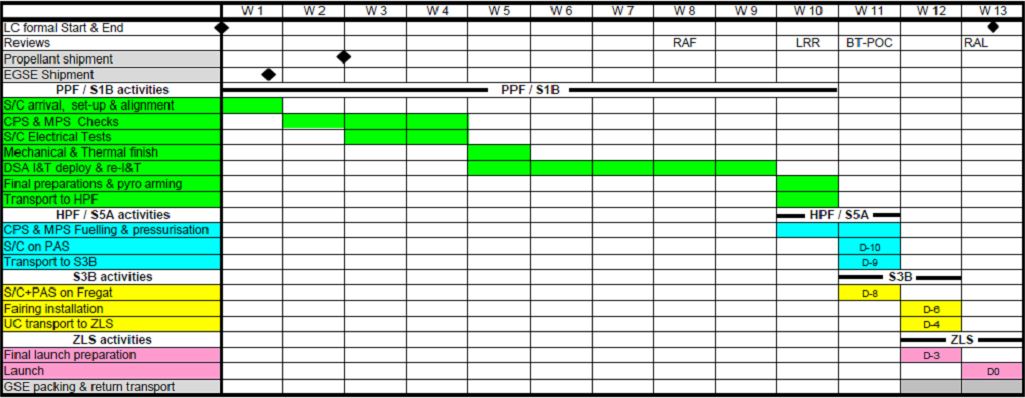
Gaia launch campaign timeline (click to enlarge and get sharper view)
Detailed explanation of the colour code and the acronyms used:
PPF, where all activities in green are done, means Payload Preparation Facility. It is the clean room where the final integration and check of the spacecraft are completed, before loading of the propellant in the tanks.
HPF, activities in blue, means Hazardous Payload Facility. Here the spacecraft will be loaded with fuel.
The activities in yellow are done in a location called S3B with S3B indicating the number of the room. Other room numbers mentioned in the timeline are S1B (green activities) and S5B (blue activities).
Last is the ZLS (activities in pink) which means Zone Lancement Soyuz. That’s the launch pad. There, the fairing containing the spacecraft will be mounted on top of the rocket.
Acronyms:
CPS = Chemical Propulsion System
MPS = Micro-Propulsion System
DSA = Deployable Sunshield Assembly
I & T = Integration & Test
PAS = Payload Adopter System
UC = Upper Composite
GSE = Ground Support Equipment
MPS = Micro-Propulsion System
DSA = Deployable Sunshield Assembly
I & T = Integration & Test
PAS = Payload Adopter System
UC = Upper Composite
GSE = Ground Support Equipment
With the final tests and the Mission Flight Acceptance Review successfully concluded, Gaia is now ready for launch and has been assigned a launch window from 17 November to 5 December 2013. Meanwhile Gaia has been ‘switched off' and packed, and will be shipped to Kourou in the second half of August in order to prepare for its launch. Ready to go at last!

Gaia spacecraft at Astrium, packed in its high-tech case. Credit: Astrium SAS
The Gaia spacecraft is seen here at the Astrium premises, being packed in its high-tech case in preparation for shipping to Kourou.
The shipment of Gaia will take place in two steps:
The spacecraft will leave Toulouse on 22 August at 20:00, landing in the early morning of 23 August at Cayenne.
The deployable sunshield together with its umbrella-like mechanism will be dispatched in a separate shipment on 28 August.
Both transports will be flown by an Antonov 124 - one of the largest aircraft in the world.
The deployable sunshield together with its umbrella-like mechanism will be dispatched in a separate shipment on 28 August.
Both transports will be flown by an Antonov 124 - one of the largest aircraft in the world.
The team in Kourou
The ‘early team’ will leave a couple of days ahead of the first Antonov and will welcome the spacecraft in Cayenne, taking care of the initial phases of the launch campaign, including transport by road from the airport to the clean rooms of the launch site, unpacking and initial inspections. Ared, Joe and David will be in the early team, and Giuseppe will fly with the spacecraft on the first Antonov. He will tell us afterwards if it is more comfortable than the regular Air France.
The ‘early team’ will leave a couple of days ahead of the first Antonov and will welcome the spacecraft in Cayenne, taking care of the initial phases of the launch campaign, including transport by road from the airport to the clean rooms of the launch site, unpacking and initial inspections. Ared, Joe and David will be in the early team, and Giuseppe will fly with the spacecraft on the first Antonov. He will tell us afterwards if it is more comfortable than the regular Air France.
Gaia’s European adventure
The Gaia Flight Model (FM) spacecraft has now completed all the necessary test campaigns and is ready for shipment to the launch site.
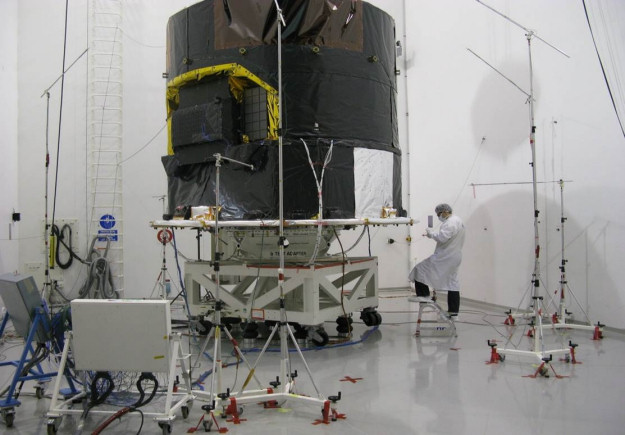
Gaia Flight Model spacecraft being prepared for acoustic testing. Credit: Astrium SAS
Acoustic Test
Gaia was placed in the acoustic test chamber at the premises of Intespace in Toulouse, France, and subjected to a simulation of the acoustic environment it will experience during launch. The extreme acoustic levels during launch are due mainly to the noise of the launcher's engines, with a smaller contribution from the airflow over the fairing during the climb through Earth's atmosphere at supersonic speeds.
Gaia was placed in the acoustic test chamber at the premises of Intespace in Toulouse, France, and subjected to a simulation of the acoustic environment it will experience during launch. The extreme acoustic levels during launch are due mainly to the noise of the launcher's engines, with a smaller contribution from the airflow over the fairing during the climb through Earth's atmosphere at supersonic speeds.
Vibration TestThe integrated Gaia FM spacecraft was subjected to verification level swept-sine vibrations along all three axes on the shakers at Intespace. The Payload Module (PLM) and Service Module (SVM) that make up the complete spacecraft have previously undergone swept-sine vibration testing at qualification levels – either as Structural Models or ProtoFlight Models – to verify their mechanical design. These latest tests, at a lower level, verified the workmanship and construction of the FM.
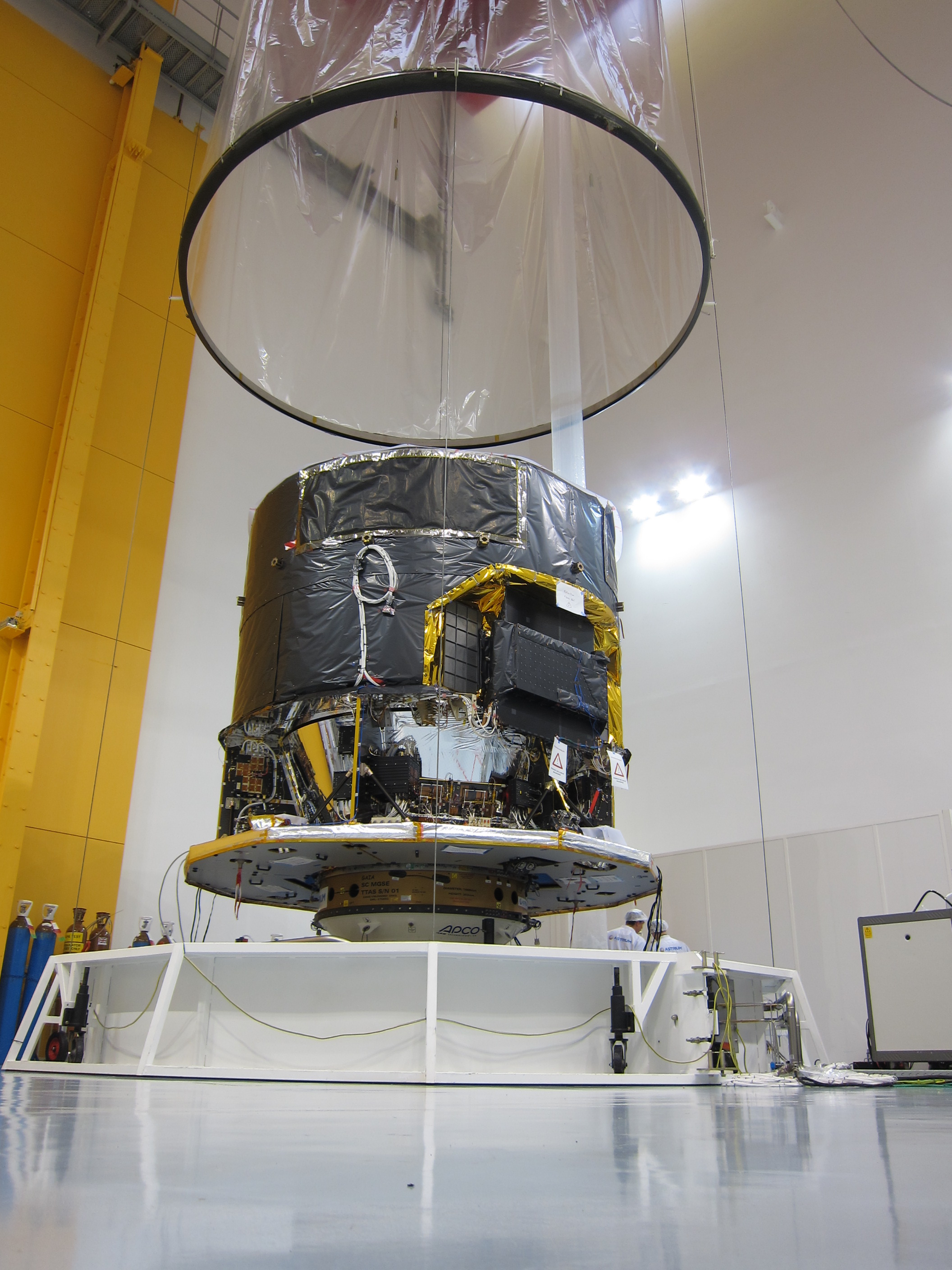
Gaia Flight Model spacecraft being prepared for leak testing. Credit: Astrium SAS
Propulsion System Leak Test
The propellants used for Gaia's propulsion systems are both highly toxic and corrosive, so it is important both for the correct operation of the mission and for the safety of the ground processing personnel during fuelling and subsequent ground operations that there are no leaks in the systems. To verify this, the Gaia FM spacecraft was enclosed in a plastic envelope and the propulsion systems were pressurised with helium. A mass spectrometer was used to detect changes in the concentration of helium inside the envelope once pressurisation had occurred. Any rise above the baseline level of helium present in the atmosphere would have indicated a leak. No leaks were detected, but, to be certain, this test will be repeated at lower sensitivity once Gaia has arrived at the launch site, to ensure that no damage has occurred in transit.
The propellants used for Gaia's propulsion systems are both highly toxic and corrosive, so it is important both for the correct operation of the mission and for the safety of the ground processing personnel during fuelling and subsequent ground operations that there are no leaks in the systems. To verify this, the Gaia FM spacecraft was enclosed in a plastic envelope and the propulsion systems were pressurised with helium. A mass spectrometer was used to detect changes in the concentration of helium inside the envelope once pressurisation had occurred. Any rise above the baseline level of helium present in the atmosphere would have indicated a leak. No leaks were detected, but, to be certain, this test will be repeated at lower sensitivity once Gaia has arrived at the launch site, to ensure that no damage has occurred in transit.
Final Tests
Following the leak test, the Gaia FM spacecraft was returned to Astrium Toulouse, where the final tests were performed. With the spacecraft back in a Class 100,000 cleanroom, the thermal tent was removed for checks following the environmental testing.
Following the leak test, the Gaia FM spacecraft was returned to Astrium Toulouse, where the final tests were performed. With the spacecraft back in a Class 100,000 cleanroom, the thermal tent was removed for checks following the environmental testing.

Gaia Flight Model spacecraft undergoing final electrical tests. Credit: Astrium SAS
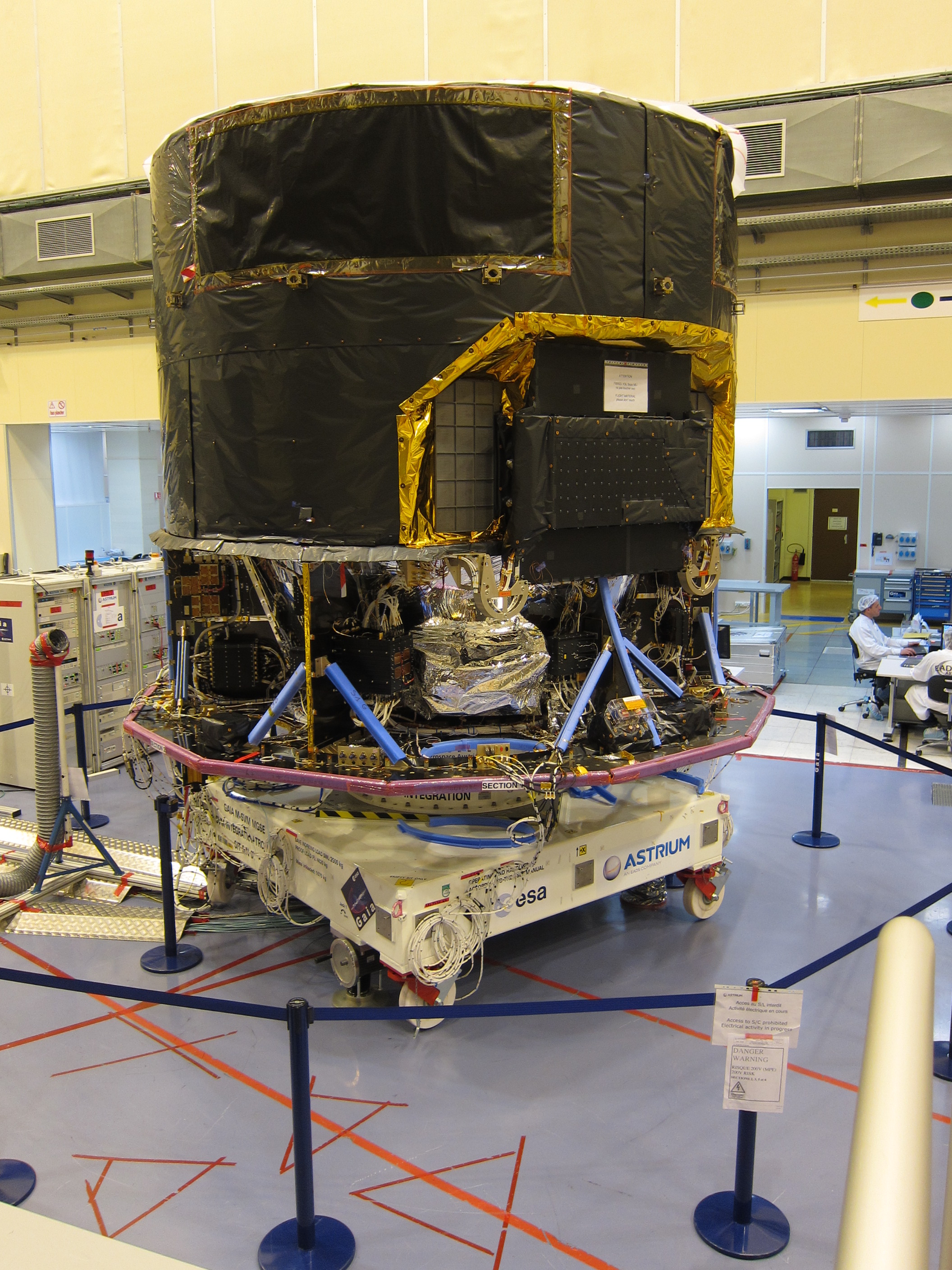
Gaia Flight Model spacecraft undergoing final electrical tests. Credit: Astrium SAS
During transport and launch, the PLM optical bench is supported by carbon-fibre reinforced polymer (CFRP) struts that supplement the glass-fibre reinforced polymer bipods; the latter provide the thermal insulation required when Gaia is operational. However, they are not strong enough to withstand the loads exerted on the PLM during launch, so the CFRP struts supplement them, but must be removed before operations commence. The Bipod Release Mechanism, which accomplishes this, was tested. In addition, final alignment checks were performed after the environmental testing and final electrical testing, verifying the functionality of all subsystems prior to shipment for launch, was conducted.
Subsequently, a series of electrical tests was performed to demonstrate the capability of the spacecraft to survive the Soyuz launch environment.
This post is based on a journal entry on ESA’s Science and Technology website.


