Particle Physics in the Sky


Figure 1

In the cosmos, the most-weakly-interacting particles may have the strongest presence. Dark matter particles are estimated to constitute more than 80% of the matter in the Universe, but are so weakly interacting with other matter that physicists have been unable to figure out what they are. Likewise, neutrinos are the most difficult to detect of the known particles, yet they are known to dominate the late stages of a star’s evolution and likely drive the supernova explosion that follows the core collapse of a dying massive star.
Within this particle landscape is the axion, a hypothetical spin-zero boson with very small mass that is considered a strong contender for dark matter [1234]. Axions have never been detected, but the theory that describes them predicts they are created when photons interact with magnetic fields or electric charges—a condition overwhelmingly met in stars. Since this process would drain energy from stars, astrophysicists can observe the evolution of stars to place bounds on the axion production rate [5]. In Physical Review Letters, Alexander Friedland of Los Alamos National Laboratory, New Mexico, and colleagues use this argument to provide the strongest upper limit to date on the strength of the interaction between axions and electromagnetic fields [6]. Their results provide feedback into theoretical models of axions and can be used to assess the sensitivity of axion detectors. On another level, their work highlights the role of stars as particle-physics laboratories, complementary to those on Earth.
At the beginning of its life, a star like our Sun burns hydrogen. The more massive a star is, the brighter it shines and the hotter its surface. This relationship is captured in the Hertzsprung-Russell (HR) diagram (see Fig. 1), which plots the brightness of known stars on the vertical axis and their surface temperatures (or color) on the horizontal axis. On such a plot, hydrogen-burning stars fall along the “main sequence.” After hydrogen is used up, helium burning takes over in the center, hydrogen burns in a shell, and the stellar envelope expands: the star ends up in the red-giant region of the diagram with a colder surface temperature (red color). Normally, it is at this point that a massive star would begin its “blue loop,” a short phase of contraction and re-expansion at the end of helium burning that takes the star horizontally across the HR diagram toward a hotter surface (blue color) and back (Fig. 1). Based on a numerical analysis of these evolution sequences, Friedland et al. show that, if the photon-axion coupling were sufficiently strong, excessive axion losses would prevent stars in the range between 8 and 12 solar masses from following this trajectory, which would contradict a range of astronomical observation.
The authors show that the very existence of the blue-loop phase puts a severe limit on the strength of the axion-photon coupling. Generically, axions should decay into two photons, although at an extremely low rate. The same interaction also means an axion could convert into a photon (or the other way round) in the presence of electric or magnetic fields—the latter playing the role of one of the two decay photons. As a result, thermal photons in the hot plasma within a star could convert to axions in the fluctuating electric fields provided by charged particles. It is this process that produces axions in stars and efficiently drains energy, provided the axion-photon coupling is sufficiently strong.
Friedland et al.’s work complements other tests of the hypothesis that axions are abundantly produced in stars. For example, following decades of successfully observing solar neutrinos, researchers have also tried to detect axions directly from the Sun. The search for solar axions began at Brookhaven National Laboratory in the US and the University of Tokyo, but the largest “axion helioscope” is CERN’s Axion Solar Telescope (CAST), which has taken data since 2003 [7]. CAST consists of one of the Large Hadron Collider’s decommissioned superconducting prototype magnets, which is oriented toward the Sun and designed to look for x rays that would arise from solar axions turning into photons as they travel 10 meters down the magnet bores. This conversion would reverse the original production process of axions from photons in the Sun. CAST has not found a signal, though Friedland et al.’s new blue-loop bound on the axion-photon coupling shows that CAST was not sensitive enough. The International Axion Observatory (IAXO), which is currently in the design phase, will be a much bigger helioscope and have a sensitivity far exceeding CAST or the new blue-loop limit [8].
Neutrino astronomy is another powerful tool with which to learn about axions. When a star collapses, it emits a huge amount of energy in the form of a short burst of neutrinos. If axions were produced in nucleon interactions, they would carry away some of this energy and shorten the neutrino burst. On 23 February 1987, astrophysicists observed about two-dozen neutrinos over 10 seconds from supernova SN 1987A. The duration and strength of this burst agreed well with what was expected, suggesting that not too much energy could have been produced in the form of axions [5]. Several multipurpose neutrino megadetectors are in operation worldwide; proposals for others that would register a high-statistics neutrino signal from a galactic supernova (expected to occur every few decades) are under consideration. Besides learning about the astrophysics of core collapse and the properties of neutrinos, these detectors could validate and improve upon the axion limits obtained from observing SN 1987A.
The SN 1987A bound is, however, not restrictive enough to say that axions don’t strongly affect the cooling of neutron stars. Moreover, if axions interact with electrons (which is quite possible, but not required by current theories) they could also noticeably impact the evolution of other stars than the ones considered by Friedland et al. There exist some indications that white dwarfs—stellar remnants too light to become a neutron star—might be cooling faster than expected by standard processes alone, an effect that could be attributed to axion emission. This hypothesis certainly remains speculative for now, but could be tested with the IAXO project by looking for solar axions [8]. It could also be tested with more careful studies of globular cluster stars that are currently under way at the Pontifical Catholic University in Chile, using modern astronomical data.
The biggest prize would be to not only detect axions but to identify them as dark matter. If axions are the particles that make up dark matter, it would mean their interactions are too feeble for stars to produce them efficiently but strong enough that they could emerge from the early Universe in just the right amount to account for all the observed dark matter. Friedland et al.’s result, which sets an upper limit on axion-photon interactions, leaves this possibility open. Moreover, if axions are the dark matter, they must be streaming through our laboratories in large numbers. Axion dark matter experiments, like the CAST helioscope, look for the axions’ predicted conversion into photons in the presence of a magnetic field [9]. A vastly improved version of the Axion Dark Matter eXperiment (ADMX) is being commissioned at the University of Washington, Seattle. It uses a high-quality microwave cavity in a 10-Tesla magnetic field as a conversion volume and a novel, nearly quantum-limited microwave amplifier [10]. Associated developments are being pursued at Yale, while researchers at DESY in Hamburg and at the Max Planck Institute for Physics in Munich [11] are working on new ideas to search for axion dark matter.
The search for axions and their particle relatives remains a showcase example of the power of the “heavenly laboratories” to learn about particle-physics conjectures. Friedland et al.’s new argument provides another beautiful case in point. The next generation experiments could still turn up solar axions. The new round of axion dark matter searches are poised to find them, if indeed they are the main stuff making up our universe.
Weighing Models of Neutron Stars


Synopsis Image

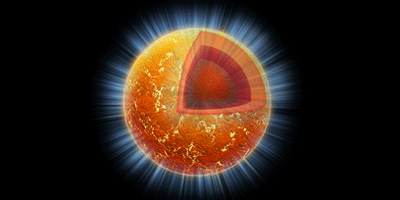
Nuclear fusion reactions in stars produce many elements found on Earth, but only those with atomic numbers up to that of iron. Heavier elements may have been created during previous supernova explosions of massive stars, or they may have been somehow ripped from the outer crust of superdense neutron stars that those explosions left behind.
If neutron stars indeed provide the heavy elements, their abundance should reflect the composition of the kilometer-thick crust, which varies rapidly with depth because increasing neutron density favors heavier nuclei. Now, in Physical Review Letters, researchers report precision measurements of the mass of short-lived zinc isotopes, which modify the predicted crust composition. The international team of scientists running the ISOLTRAP experiment at CERN’s radioactive ion-beam facility, ISOLDE, measured the mass of zinc-82 (Zn-82), a neutron-rich isotope that existing models predict is prevalent in the crust of neutron stars. The researchers exploited a new technique to rapidly separate the few desired zinc ions created in a pulse from thousands of others with almost the same mass. They then measured the Zn-82 mass relative to a reference with an accuracy of 40 parts per billion. All of this must be done very quickly, because Zn-82 decays with a half-life of only a quarter of a second.
The new mass measurement supports a revised model of neutron-star crusts in which the zinc-82 is in fact no longer present, but is instead replaced by nickel-78. The revised model also fits nicely with the recent discovery of a particular neutron star that is heavier than would be possible using earlier models. – Don Monroe

Seeing into the Void


Synopsis Image

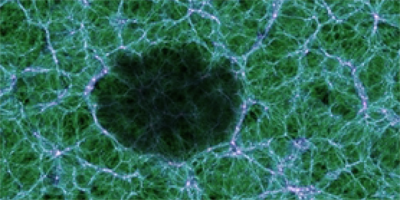
The mass concentrated inside a cluster of galaxies warps the surrounding spacetime, causing background galaxies to appear brighter or distorted. A similar sort of “gravitational lensing” occurs for light passing through a void with lower-than-average density. The standard approach predicts that these low-mass regions cause a dimming, but new calculations in Physical Review Letters show that cosmic voids can actually produce brightening that overwhelms the standard lensing signal. The results may affect the interpretation of large-scale astronomical surveys.
Astronomers measure gravitational lensing to obtain the mass of the lensing object, or to estimate the mass density along a particular line of sight. Most of the emphasis has been on high concentrations of mass, but light will also be affected by galaxy-poor voids, which are tens to hundreds of millions of light years across and together account for more than half the volume of the universe. Previous lensing models considered only the light-bending aspect of a void, which causes a background object to appear smaller (and thus slightly dimmer) than it really is.
Krzysztof Bolejko from the University of Sydney in Australia and his colleagues made a more careful accounting of the lensing by voids. In their full relativistic analysis, they included a wavelength-stretching effect that occurs because voids are expanding faster than the universe in general. This added “redshift” leads to an overestimate of the distance to objects sitting near the far side of a void, and thus they will appear brighter than expected. The authors speculate that this void effect may explain some statistical anomalies in supernovae surveys. – Michael Schirber

NASA's Orion Sees Flawless Fairing Separation in Second Test

The three massive panels protecting a test version of NASA's Orion multipurpose crew vehicle successfully fell away from the spacecraft Wednesday in a test of a system that will protect Orion during its first trip to space next year.
The panels, called fairings, encase Orion's service module and shield it from the heat, wind and acoustics it will experience during the spacecraft's climb into space. The service module, located directly below the crew capsule, will contain the in-space propulsion capability for orbital transfer, attitude control and high-altitude ascent aborts when Orion begins carrying humans in 2021. It also will generate and store power and provide thermal control, water and air for the astronauts. The service module will remain connected to the crew module until just before the capsule returns to Earth. During Exploration Flight Test-1 (EFT-1), the spacecraft's flight test next year, a test service module will be attached to the capsule.
The three panels or fairings encapsulating a stand-in for Orion’s service module successfully detach and fall into the Fairing Catch System during a test Nov. 6, 2013 at Lockheed Martin’s facility in Sunnyvale, Calif.
Image Credit: 
Lockheed Martin
"Hardware separation events like this are absolutely critical to the mission and some of the more complicated things we do," said Mark Geyer, Orion program manager at NASA's Johnson Space Center in Houston. "We want to know we've got the design exactly right and that it can be counted on in space before we ever launch."
Unlike conventional rocket fairings, these panels are designed to support half of the weight of Orion's crew module and launch abort system during launch and ascent, which improves performance, saves weight and maximizes the size and capability of the spacecraft. Each panel is 14 feet high and 13 feet wide.
The fairings' work is done soon after launch. They must be jettisoned when Orion has reached an altitude of about 560,000 feet. To make that possible, six breakable joints and six explosive separation bolts are used to connect the fairing panels to the rocket and each other. In a carefully timed sequence, the joints are fired apart, followed shortly by the bolts. Once all of the pyrotechnics have detonated, six spring assemblies will push the three panels away, leaving the service and crew module exposed to space as they travel onward.
The three panels or fairing that moments before encapsulated a stand-in for Orion’s service module lay safely in the Fairing Catch System after a test demonstrating their detachment system on Nov. 6, 2013, at Lockheed Martin’s facility in Sunnyvale, Calif.
Image Credit: 
Lockheed Martin
This test, conducted by Orion's primary contractor, Lockheed Martin, at the company's Sunnyvale, Calif., facility, was the second test of the fairing separation system. The first occurred in June, when one of the three fairing panels did not completely detach. Engineers determined the issue was caused when the top edge of the fairing came into contact with the adapter ring and kept it from rotating away and releasing from the spacecraft. Because of the engineers' confidence in successfully eliminating the interference, they maintained plans to increase this week's test fidelity by emulating the thermal loads experienced by the fairings during ascent. They used strip heaters to heat one of the fairings to 200 degrees Fahrenheit and simulate the temperatures the panels will experience.
Exploration Flight Test-1 is scheduled for September 2014. During that flight, an uncrewed Orion will launch to an altitude of 3,600 miles, more than 15 times farther into space than the International Space Station. It will orbit Earth twice before re-entering the atmosphere as fast as 20,000 mph.
The data gathered during the flight will influence design decisions, authenticate existing computer models, and innovative new approaches to space systems development It also will reduce overall mission risks and costs for subsequent Orion missions to an asteroid and eventually Mars.
For information about Orion and EFT-1, visit:

At the Heart of a Black Hole


Synopsis Image

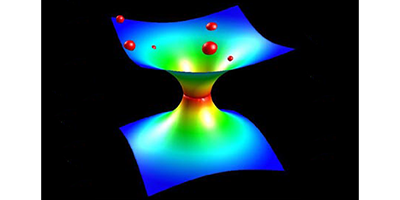
General relativity has been successful in describing the macroscopic properties of black holes. However, at the microscopic level, it predicts that black holes have a singularity at their cores: a region where the gravitational field is infinitely strong. Within the picture of gravity presented by general relativity, such a singularity would destroy all information about the quantum states of matter falling into a black hole. Yet one of the basic tenets of quantum mechanics is that information is preserved. The loss of information in a singularity is thus paradoxical and points to a fundamental incompatibility between general relativity and quantum mechanics. A long-standing hope has been that the application of a quantum theory of gravity to the description of black holes would resolve these contradictions.
Now, writing in Physical Review Letters, Rodolfo Gambini at the University of the Republic in Uruguay and Jorge Pullin at Louisiana State University, Baton Rouge, show that the quantization of a special class of black holes—known as spherically symmetric black holes—is indeed possible within a framework for quantum gravity known as loop quantum gravity. Their analysis shows that a region of highly curved spacetime (where quantum effects of gravity can be manifest), rather than a singularity, is what makes up the core of a black hole. While this promising theory removes the singularity implied by classical general relativity, further research will be needed to establish whether these results solve the information loss paradox and if the approach may be generalized to other classes of black holes. – Abhishek Agarwal

Black-Hole Hunting with a Gas Cloud


Synopsis Image

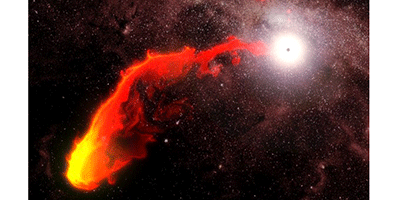
Astronomers estimate that the center of our Galaxy is teeming with black holes. Detecting these highly compact objects is challenging, but an opportunity may arrive at the end of the summer in the form of a large gas cloud passing through the galactic center. If this cloud encounters a black hole in its path, the hole will devour some of the material, releasing x rays in the process. A new paper in Physical Review Letters calculates the odds of us seeing such an event.
Black holes and neutron stars can form when a massive star runs out of nuclear fuel and collapses onto itself. Over time, some of these objects migrate towards the center of the galaxy. Previous work has predicted that as many as 20,000 black holes—and a similar number of neutron stars—may be hiding within a few light years of the galactic center.
One way to spot these burnt-out objects is to douse them with fresh “fuel” that lights up as it accretes onto the surface. Imre Bartos of Columbia University, New York, and colleagues consider the likelihood of such fireworks occurring inside a gas cloud, named G2, which is currently swooping around the galactic center, with a closest approach scheduled for September 2013. The researchers calculate that this cloud, which is roughly three times wider than the orbit of Pluto, may encounter around ten black holes along its path. However, the x-ray signal from these events is probably detectable only in some special cases. Notably, current instruments could potentially observe G2 collisions with intermediate mass black holes, which are an unconfirmed class of objects 1000 times more massive than normal black holes. – Michael Schirber

Fundamental Constant Doesn’t Budge in High Gravity


Synopsis Image

The fundamental constants of nature may not be constant in a changing gravitational field. A new study tests this hypothesis by analyzing absorption lines from ions in the vicinity of a very dense white dwarf star. The lines show no significant deviation compared to those measured on Earth. The authors conclude in Physical Review Letters that any variations in the fine structure constant from gravity must be less than one part in ten thousand.
Certain theories predict the existence of scalar fields that pervade all of space and may influence the value of fundamental masses and coupling constants. One way to detect this influence is to make a measurement in a stronger gravity field, where the scalar field should be more concentrated and fundamental constants may take a different value. Previous experiments have looked unsuccessfully for a change in the (electromagnetic) fine structure constant using small (around 3%) gravity variations on Earth.
To explore stronger gravity effects, Julian Berengut of the University of New South Wales, Australia, and his colleagues analyzed astronomical data from a white dwarf. Specifically, they studied absorption lines from iron and nickel ions in the dwarf’s atmosphere, where the gravitational potential is 30,000 times greater than Earth’s. The researchers compared the dwarf lines to the same lines observed in the laboratory and found no discrepancy, which implies a “constant” fine structure constant to within limits that are similar to earlier studies. However, the authors claim the white dwarf constraint can be tightened by a factor of 100 with improved laboratory measurements. – Michael Schirber

A Long, Hard Look at Cosmic-Ray Positrons


Synopsis Image

Recent experiments have revealed a striking feature of the high-energy cosmic rays coming from outer space: they contain an odd excess of high-energy positrons, the antiparticles of electrons. The result, obtained through years of balloon and space-borne measurements, is not compatible with current astrophysical models. The excess points at yet-to-be-identified sources of cosmic-ray positrons, which could be nearby cosmic bodies such as pulsars or, as many speculated, dark matter annihilation events.
Previous positron surveys, most recently the AMS experiment on the Earth-orbiting International Space Station, have focused on the accurate assessment of the positron-electron fraction (how many positrons are present for each electron). But a more complete characterization requires knowing the energy spectrum of positrons (the absolute number of positrons as a function of particle energy). This is more challenging, as it requires absolute calibration of the detection scheme over a wide range of energies.
Now, a large international collaboration running PAMELA—the satellite-based experiment that delivered the first conclusive evidence for the high-energy positron excess in 2009—has extended its previous surveys and analyzed about 25000 positrons collected over three years of measurements, with energies falling in the 0.5300 giga-electron-volt range. The results, as reported in Physical Review Letters, offer the most accurate picture to date of the information-rich, high-energy part of the positron spectrum.
While confirming the positron abundance known from the previous positron-fraction measurements, the data provide new and complementary information: precise knowledge of the positron energy spectrum will pose further constraints on theories, helping vet the multitude of models, including dark-matter-based ones, that seek to pinpoint the mysterious sources of the most energetic positrons. – Matteo Rini

Positrons Galore


Figure 2

Antimatter is rare in the universe today. As far as we know, all relic antimatter produced in the big bang disappeared long ago in annihilation reactions with matter particles. What this means is that any antimatter particles that we can detect in the flux of energetic cosmic rays near Earth must have been created by “new” sources within our Milky Way Galaxy. (Antimatter particles from extragalactic sources are also conceivable, but they are exceedingly unlikely to make it to Earth before losing all their energy or annihilating.) Because there is a limited amount of energetic antimatter from space raining down upon the Earth, antiparticles serve as unique messengers of high-energy phenomena in the cosmos, or signatures of exotic new physics.
Now, an eagerly anticipated survey of cosmic-ray positrons—the antiparticle of the electron—is being reported in Physical Review Letters by the collaboration running the Alpha Magnetic Spectrometer (AMS), a particle detector experiment on board the Earth-orbiting International Space Station [1]. In the first scientific report from the AMS, an experiment 18 years in the making that began taking data in May 2011, the collaboration presents a measurement of the “positron fraction,” the ratio of the number of positrons to the total number of electrons plus positrons, at energies between 0.5 and 350 giga-electron-volts (GeV) (Fig. 1). The 400,000 positrons they have measured constitute the largest set of cosmic-ray positron data, increasing the total world sample a hundredfold. In addition, the range of the reported positron fraction extends out to a few hundred GeV, beyond the reach of previous experiments flown on high-altitude balloons [2] or space shuttles and satellites [3] (see 5 January 2012 Synopsis). The features in the AMS’s positron distribution are a striking confirmation—with unprecedented statistical detail—of what has been reported previously by satellite experiments: an excess of positrons over what we expect from known galactic energetic phenomena. There is a tantalizing—and much touted—possibility that this excess could be a signature of dark matter, though it’s much too soon to rule out more prosaic explanations.
Antimatter arises as a by-product of ordinary cosmic-ray nuclei interacting with the dilute interstellar gas. For example, when an energetic cosmic-ray proton—say, one produced by a supernova remnant—collides with the nucleus of a hydrogen atom in the interstellar medium, the interaction can produce pions. These particles decay into muons and, ultimately, into electrons and positrons in equal numbers. Energetic electrons and positrons arriving at Earth will therefore consist of a mixture of “primary” negatively charged electrons, from the same astrophysical sources that produce cosmic-ray nuclei in the first place, and additional “secondary” positrons and electrons from cosmic-ray interactions (Fig. 2). Based on models of particle interactions and transport processes in the Galaxy [4], particle astrophysicists predict a positron fraction (at Earth) that decreases, monotonically, at energies greater than 1GeV (see the grey band in Fig. 1).
Some 20 years ago, this picture was largely substantiated by spectrometers flown on high-altitude balloons (e.g., the HEAT, TS93, and CAPRICE experiments [2]). But there were also hints of a departure from this behavior at energies beyond about 10GeV, where a larger-than-expected positron fraction seemed to signal the possibility of an additional, unknown source of antimatter. Later, space-borne instruments—such as the AMS-01 (an AMS prototype), PAMELA, and Fermi-LAT—were able to measure this rise in the positron fraction with substantially better statistics and over a wider energy range [3].
There has been no shortage of speculation about what might cause the positron “excess” above 10GeV. One idea is that relatively nearby cosmic bodies, such as pulsars, act as accelerators and colliders that produce antimatter [5], much like our terrestrial Large Hadron Collider. But a more exciting possibility is that the positrons come from the annihilation of dark matter particles, which may populate the Milky Way and its halo [6]. Dark matter is, after all, a dominant form of the matter-energy budget of the Universe, but we don’t know its particle nature or how it interacts with itself and with normal matter (other than through gravitational interactions). It is no overstatement to say that identifying the dark matter is one of the greatest problems in modern science.
This is why the particle astrophysics community has been eagerly awaiting a confirmation of the positron fraction features seen by PAMELA and Fermi-LAT. The AMS is the most complex particle physics experiment in space. It includes a battery of detectors that can identify the mass, charge, and energy of particles and antiparticles with high precision, in particular, by tracking the particles’ deflection through a permanent magnet located at the core of the instrument. The latter is a capability that Fermi-LAT doesn’t have, which is one reason why there were such large uncertainties in its positron spectrum. And all of these detector experiments are faced with the challenge of precisely identifying positrons at high energies, where the background is copious. A 100-GeV positron resembles a 100-GeV proton in many respects, but protons outnumber positrons by some three orders of magnitude—a problem that becomes worse with energy.
The new AMS results agree beautifully with what PAMELA observed, thus reinforcing the trend that the positron fraction rises with energy, but this time, with unprecedented statistics and background controls. Although there is an apparent discrepancy between the PAMELA and new AMS data below about 2GeV, it is not a concern: cosmic particles have to swim upstream against the solar wind to reach Earth and the effects of this “solar modulation” on the particle populations may be different for the two instruments. Such effects should become negligible beyond a few GeV.
With so many experiments pointing to an excess of antimatter, we’re now in a position to ask the following: Where does it come from? This may take a while to resolve. There are many theoretical scenarios, all with enough uncertainties that they seem endlessly adaptable to every quirk, kink, or hint of structure in the positron spectrum. One can invoke energetic gamma rays that convert into electron-positron pairs in the vicinity of the magnetic poles of pulsars [7]. One can imagine that positrons are produced in the decay of radioisotopes within a cosmic accelerator, say a supernova remnant [8]. And, there is the exciting possibility that all of these experiments have seen the “smoking gun” signal of dark matter particles annihilating in the galactic halo [6]. There are significant modeling uncertainties in all of these scenarios, though, such as how particles propagate through the Galaxy, the mass of the dark matter particles, and their interaction rates. But the ideas are attractive and remain fodder for lively speculation.
How will we tell? The AMS collaboration doesn’t speculate in their first report. No doubt many ideas will be generated along with attempts to fit the AMS positron fraction to favored models, while accommodating constraints that come from other experiments [91011]. But perhaps a definitive answer will eventually be forthcoming. For one thing, the new AMS data have an unprecedented sensitivity to the curvature and features in the positron spectrum. Already, we can see a significant change of slope in the positron fraction near 100GeV that will need to be explained. The AMS is only two years into its projected ten-year (or longer) lifetime. There are predictions that the error bars on the data will decrease further. There should also be measurements of the positron fraction spectrum up to higher energies, and a separate measurement of the absolute energy spectra of positrons and electrons. But we will have to be patient: the particle fluxes fall off rapidly with energy, so accumulating precise data above 200GeV or so will be a painfully slow affair. Meanwhile there will be a wealth of other data to come from the AMS. The experiment is in an excellent position to identify antiprotons, cosmic-ray nuclei, and more speculatively, to search for antinuclei.